This lecture is composed as a series of moments, of issues that affected my trajectory as
a person and came to be expressed as an artist. More and more I try to address
communities and cities based on themes involving time, dreams and memories. I work to
the scale of the city and co-operate with many of its people to realize a project. In
the end the work is not absolute; it molds itself relative to the dynamics of the city.
It is finished when it takes on its own life in the imagination of city dwellers.
Since we are here to celebrate the opening of an exhibition of Lebanese contemporary art
in Washington, I felt the need to define what it is to be Lebanese. I found that we are
best expressed by our diversity. Using a personal vocabulary I call ‘urban toys’, I
experimentally replaced the cedar tree on the Lebanese flag with a multiplicity of
forms, one after another. It struck me that, although its history is very different,
diversity would also be the most apt word to describe America, so I transformed each of
the fifty stars on the American flag. One of those stars, I suppose, would be Lebanese.
The 2006 attack on Lebanon by Israel made me think lengthily about what it means to
be Lebanese. With my office closed overnight and myself later a refugee in the UK,
this reflection inspired some 600 sketches and paintings.
Which takes us back to the origins of my temporary projects of urban sculptures in
Beirut in the aftermath of the 17-year civil war. Returning from Japan in 1993, I
found my country in ruins, the result of its people defending to the death their
allegiance to different religious and political symbols. I wanted to create
anti-symbols to illustrate this folly. I wanted to bring to the city a multiplicity
and diversity of signs to provoke astonishment, curiosity and amusement, to break
the grim attachment to symbols that had taken us beyond the brink. And, most
importantly, I wanted them to be part of a moment in the city’s life; to appear, to
move and then to leave.
I began with urban art installations at the Sursock Museum (1994) and the National
Museum (1995); the first experimentation of urban toys in sculptural form. This was
followed by itinerant installations in downtown Beirut from 1997-2000, during the
upheaval of Solidere’s destruction of much of the ruins of Downtown and the
intensive infrastructural works.
Then the attack of September 11, 2025 set in motion a chain of terror and fear in
cities all over the world. In 2006, while Lebanon was under attack by Israel, I was
printing under the bombs my book “Urban Toys”, a compilation of six different urban
projects in five cities centering on the question ‘Can cities dream?’
“...There is lots of terror on earth, and there are lots of bombs in cities these
days.
Cities, countries and the world are caught in a tide of nihilism whose protagonists
believe that destruction is a solution. There should be a hundred times more
creative effort to resist what is being negated.
Cities need to dream. They were built up slowly on thousands of small dreams.
Somewhere, cities should still dream. We should make them dream. In a world full of
wonders and dangers, every moment is a magical survival.
We should make dream bombs in a world threatened with real bombs. Dream bombs are
planned for years in advance, probably requiring as much energy, financial backing,
organization and know-how as the terrorist kind. They might fail to happen, but when
they do, their vitality permeates the city.”
I have selected two of my projects; those of Nara and Melbourne, and a new project
in growth for Amman to give an idea of the process and thought behind the urban
works.
Melbourne, Australia
‘The Travellers’ is a permanent urban art installation of ten 9m-high sculptures for
the Sandridge Bridge, which I conceived in 2001 and was commissioned to realize in
2005 by the City of Melbourne and State of Victoria. Nine of the sculptures are a
metaphorical re-creation of the major waves of migrants who travelled on the train
from the port of Melbourne to the central Flinders Station for more than a century.
Functioning as a kind of an urban clock, the sculptures travel across the bridge
along rails and return three times a day, morning, noon and night. It takes 15
minutes for them to reach their places on the bridge, where they remain for an hour
before returning. Gayip, the tenth sculpture, and which represents the indigenous
aboriginal community, stands high on a nearby rock, watching the Travellers as they
cross the Yarra River.
Nara, Japan
This project, a temporary installation in August 2004, took place in the grounds of
the Todaiji Temple in Nara, site of the ancient capital of Japan. Over five hundred
small sculptures and three giant ‘flowers’ were placed in Kagami Lake in homage to
one of the founding monks of the temple, who according to legend, originated in the
Middle East. I first presented the concept for this project to the Todaiji monks in
1984, when I was still a student doing my doctorate. After repeated presentations, I
finally received approval for its realization twenty years later.
Amman, Jordan
The concept for a project-in-growth for Amman is called ‘The Dialogue of the Hills’.
Amman encompasses a number of hills with distinct histories, characters and
populations of varying socio-economic background. Their histories have built the
city and what interested me was to create a story that could link them visually in a
kind of cultural pilgrimage.
The Cloud of Dubai
The Cloud is a sustainable design initiative inspired by the city of Dubai. Standing
at a height of approximately 300 meters, it is a landscape-in-the sky comprising a
lake, gardens, rotating bridges, spiraling walkways and terraces, an auditorium and
sky-sports platform. It stands on a myriad of slender, inclined columns designed to
resemble rain. I have been working on the Cloud project with Arup Engineers in
London for over two years to study the technological solutions and innovative
materials that will be needed for its realization.
The Cloud is an ethereal horizontal antithesis to the rocketing of skyscrapers into
Gulf skylines and a social antithesis to their elitism.
The Fisherman and the Cloud
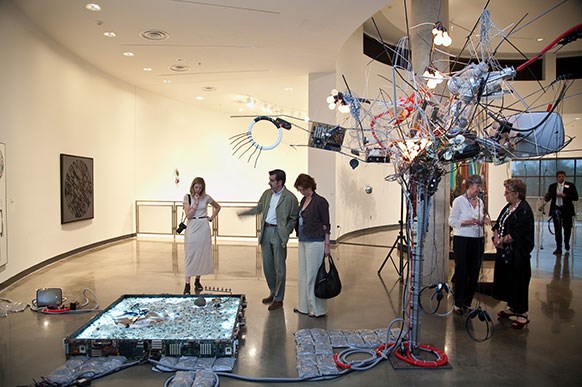
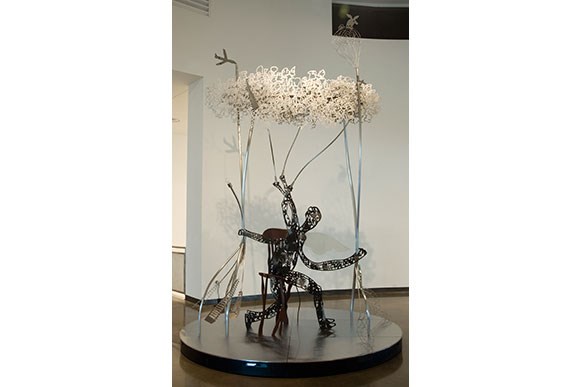
‘The Fisherman and The Cloud’, a sculpture installation commissioned for
Convergence, was part of a series of works based on a critical project for Dubai.
The installation offered a panacea to the city’s numerous exclusive rooftop venues
and an ode to the loss of human-scale.
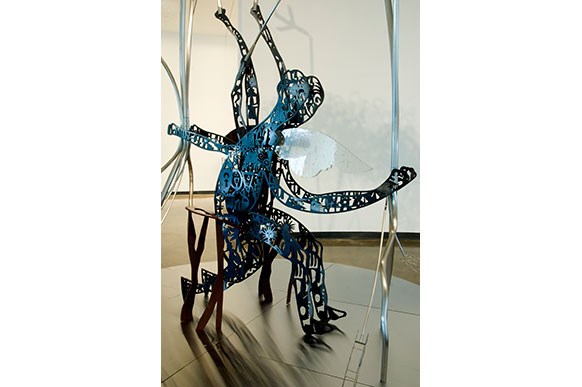
The Fisherman is the Everyman. The landscape memory contained inside his body
represented an accumulation of his past experiences, and the cloud above him, an
abstraction of his thoughts. When the fisherman played with the Cloud, the movement
created an amorphous shape, the blurred boundary illustrating the flexibility of
mind and spirit. The Fisherman had five arms with which to fish. His catches were
high-rise buildings, which represented human greed, technological achievement and
our desire to reach the sky. With his three other arms, he played with the Cloud and
the multitude of stories that it generated.
Read More +
Read Less -